
Bang trends in 2026: which one to choose according to your face shape
2026 is the year of bangs. From Brontë Bangs to the sophisticated Soft-Frame, the visagism guide to find the perfect bangs for your face shape.
What you will learn in this article:
- Why 2026 is officially the "year of bangs".
- The 8 trending bang styles and how they differ technically.
- An applied visagism guide for all 7 face shapes.
- Which bangs your hair type can hold: fine, thick, straight, wavy or curly.
- How to style them with wrap-drying, and which products ruin them.
- How often to trim them depending on the style you choose.
Professional hairdressing has undergone a metamorphosis in the transition to 2026. If previous seasons were dominated by "bob" cuts, 2026 has been crowned the "year of bangs". The modern concept has distanced itself from the rigid, dense constructions of the past: now softness, fluidity and a meticulous degree of customisation rule.
The shift is not only about shape, it is about hierarchy. Bangs have stopped being an add-on to the cut and have become the axis around which the whole hairstyle is built: layer length, parting and even colour are decided after them, not before.
- Are bangs in style in 2026?
- The 8 trending bangs of 2026
- Visagism: which bangs for your face
- Which bangs suit your hair type
- Styling and maintenance
Are bangs in style in 2026?
Yes, and fairly unanimously so. Salons and leading publications agree that 2026 is the year bangs take centre stage again, with one condition: soft, textured and adapted to the face. What is over is the dense, closed fringe with a continuous straight line, cut the same way for everyone.
The technical key behind the shift is called negative space: hollowing out tiny sections of the fringe so the skin of the forehead shows through between the strands. That air removes the harshness of the horizontal line, adds movement and makes the cut far easier to live with, because it opens up on its own as it grows instead of collapsing.
A note on vocabulary: bangs (American English) and fringe (British English) are the same thing, and both terms describe every style below.
The 8 trending bangs of 2026
The styles ruling the season draw on the 1960s and 1970s, filtered through contemporary texturising techniques. The common denominator is always the same: breaking up solid shapes.
Brontë Bangs

Inspired by the aesthetics of the Brontë sisters' era, these are long bangs with natural texture and a bohemian air, longer at the ends to softly frame the face.
- Vibe: "Thought Daughter", poetic and literary.
- Ideal for: oval and elongated faces.
- Technique: internal hollowing with a razor or thinning shears, so the transition between the front section and the rest of the hair is imperceptible.
- Maintenance: low. As they grow, the ends melt into the side layers.
Soft-Frame Bangs
The chic evolution of curtain bangs: light and point-cut, they fall gently over the cheekbones creating a subtle frame. It is the "Gucci editorial style" par excellence.
- Technique: demands an impeccable centre parting and a graduation that caresses the jaw. The shortest point is the centre, over the bridge of the nose, opening diagonally towards the sides.
- Ideal for: round and square faces.
- Practical detail: by clearing the centre of the face, they are among the best options for glasses wearers.
Curtain and Bardot Bangs
Curtain bangs have refused to leave the trend cycle for years, and in 2026 they remain the most requested style, in two versions. The contemporary one is the Soft-Frame you just saw. The classic one is the Bardot, sixties-inspired, with more body at the root and a deliberately undone bed head effect.
Their popularity has a practical explanation rather than an aesthetic one: they are the most democratic bangs there are. They flatter almost any bone structure, work well with glasses and, above all, make the grow-out phase bearable. When curtain bangs get too long they do not become a problem, they become longer curtains.
- Ideal for: almost every face shape, especially round and heart-shaped.
- Maintenance: medium-low, 4 to 6 weeks.
Bottleneck Bangs

Takes its name from its silhouette, which mimics the curves of a bottle: shorter in the centre and curving outward as it reaches the eyes.
- Benefit: twofold. The short centre lines draw attention to the eyes, while the lateral opening projects the cheekbones upward, an optical lifting effect.
- Reference: Margot Robbie and Lily Collins.
- Technique: the cross-cutting angle has to hold the curve on its own. If the ends are left heavy, the fringe collapses onto the face and needs rescuing with product every day.
Birkin Bangs

A straight but deeply texturised fringe that rests on the eyebrows, in homage to Jane Birkin and to seventies-era Cher. It rejects severe lines through intense point-cutting work (cutting vertically with the tip of the scissors).
- Style: effortless chic.
- Maintenance: very low, it grows organically into curtain bangs.
- On very straight hair: it is the natural base for the glass hair finish, polished and reflective.
Mini Bangs: the short bangs

For the boldest: short, straight and graphic, sitting above the eyebrows or even mid-forehead. It is the manifestation of the avant-garde "cool-girl" aesthetic, and the cut that most instantly refreshes the gaze because it clears the entire upper third.
- Reference: Zoë Kravitz, Winona Ryder, Miley Cyrus and Ariana Grande.
- Two executions: strictly straight, for a graphic and dramatic effect; or choppy and point-cut, far more organic and easier to wear.
- Commitment: the highest on the list. Requires trims every 3-4 weeks, because a few extra millimetres strip away all its character.
- Works with: pixie, bixie and jaw-length bobs. It also creates a powerful contrast on long, straight hair.
Shaggy and lived-in bangs
These are the calculated rebellion of 2026. Shaggy bangs are layered, irregular and heavily point-cut, designed to blend into deconstructed cuts such as the wolf cut; they add vertical volume and a rock-rooted aesthetic that falls into place on its own.
Lived-in bangs chase something subtler: the illusion that you have not just walked out of a salon. They are cut to simulate several weeks of growth, with open ends and naturally separated strands.
To ask for them properly in the salon, the wording that works is "soft front layers", "point-cut ends" and no solid lines. Your stylist will use a razor or thinning shears to break the weight at the ends.
Curly Bangs

The myth that curls and bangs are not compatible is over. In 2026, curly bangs celebrate authentic identity.
- Key: the dry cutting technique to control elastic shrinkage.
- Best version: curly curtain bangs, which open towards the sides and add volume without imposing a rigid line on the forehead.
- Length: neither very short nor cropped. The extra weight of a medium length keeps the curl from springing up too much on the forehead.
Visagism: which bangs for your face
Choosing bangs is not an impulsive act, but a geometric calculation. Visagism studies the lines, volumes and proportions of the face to decide which cut balances its asymmetries. And bangs are the tool that most alters the perception of the facial thirds, because they act directly on the upper one.
Before going on, work out which one is yours. No measuring needed: pull your hair back, look straight into the mirror and check two things, whether your face is longer than it is wide and which of the three zones dominates (forehead, cheekbones or jaw). That is enough to recognise yourself in one of these seven outlines.
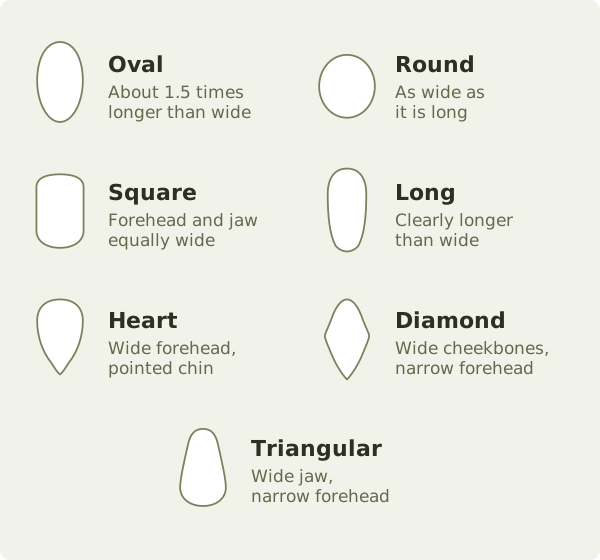
Oval face. Roughly one and a half times as long as it is wide, with soft contours. It is the most balanced proportion, so the goal is not to spoil it: no heavy masses of hair that break the symmetry. Everything works, from Brontë to textured blunt. One nuance that makes the difference: dark hair holds fuller bases, while blonde hair should not be over-thinned, since light passes through the fringe and thins it out visually.
Round face. Width and length almost identical, full cheeks, a jaw without angles. The goal is to elongate vertically and break the circularity with diagonals. Long curtain bangs with a wide central opening win: by splitting the front section they trace an inverted "V" that stretches the face. Heavily side-swept bangs and Soft-Frame styles that pass the cheekbones also work. To avoid, no discussion: dense blunt bangs on the eyebrows, which draw a horizontal and widen.
Square face. Jaw and forehead of similar width, with marked angles. The goal is to soften without hiding: curves, movement and irregular contours in the middle and lower thirds. Wispy bangs, messy Birkin and asymmetric lived-in styles work, as long as they caress the temples and blend into the sides. A cut that ends in a straight line mirrors the jaw and reinforces it.
Long or oblong face. Longer than it is wide, often with a high forehead and narrow temples. Here bangs are the most powerful corrective tool there is, because they physically cover part of the upper third and shorten the visual distance between the hairline and the chin. The ideal is straight and heavy (blunt) on the eyebrows, or a dense Birkin, paired with volume at the sides. Micro bangs are the exact opposite of what this shape needs: they expose the forehead and lengthen it further.
Heart or inverted triangle face. A wide forehead narrowing to a pointed chin. The width of the forehead needs camouflaging without weighing down the top. Bottleneck bangs are a masterpiece for this shape: they start narrow at the centre of the forehead, exactly where there is excess width, and open at cheekbone level, exactly where the face starts to taper. Light curtain bangs and layered shaggy cuts also work.
Diamond face. Very prominent cheekbones, a narrow forehead and a pointed chin, with hard lines. The goal is to soften the perimeter. Textured curtain bangs that add volume at the temples work well, along with soft side waves and side-swept fringes. What does not work are tight updos with no front strands released, which leave the cheekbones fully exposed.
Triangular or pear face. The inverse of the heart shape: a wide jaw and a narrow forehead. The strategy is to visually widen the upper third to balance the weight. Voluminous curtain bangs worked from the root, a low or deep diagonal parting, and volume at the temples. To avoid: flat bangs, a strict centre parting and solid cuts ending right at jaw level.
| Face | Geometric objective | Recommended bangs | To avoid |
|---|---|---|---|
| Oval | Preserve symmetry | Any! (Soft Curtain, Birkin, Brontë) | Excessive volume at the crown |
| Round | Elongate vertically | Long open curtain, side-swept, Soft-Frame | Straight and dense (blunt) on the eyebrows |
| Square | Soften angles | Wispy (ethereal), messy Birkin, lived-in | Hard horizontal lines and geometric cuts |
| Elongated | Shorten vertical axis | Blunt (straight and heavy), dense Birkin, full curtain | Micro bangs; flat hair with no side layers |
| Heart | Balance the chin | Bottleneck, shaggy with layers, narrow curtain | Very wide blunt bangs and heavy weight on top |
| Diamond | Soften the cheekbones | Textured curtain, side-swept fringe, soft side waves | Tight updos with no front strands released |
| Triangular (pear) | Widen the temples | Voluminous curtain from the root, low diagonal parting | Flat bangs and a strict centre parting |
Which bangs suit your hair type
Your face decides which design flatters you. Your hair texture decides whether that design is viable and how much daily work it will cost you. Ignoring this second part is the most common reason someone leaves the salon delighted and pins the fringe back ten days later.
Fine hair
The problem with fine hair is not quantity, it is that it cannot hold its own volume: it flattens under its own weight and soaks up sebum from the forehead very quickly. The temptation to take hair from far back to build a thick fringe is a mistake, because it thins out the crown and the sides.
What works are light, airy cuts: wispy, lived-in with controlled density, or curtain bangs cut softly around the perimeter. At home, lift the root with heat and a very light volumising cream. And one rule almost nobody follows: do not let them grow out too much, because the extra weight kills the bounce at the root.
Thick, abundant hair
Thick hair expands horizontally and can end up swallowing the features. It allows solid bases and plenty of body, but demands deep thinning and internal texturising: hollowing out the volume from the inside without touching the surface.
The detail that prevents the dreaded mushroom effect is thinning the last few centimetres of the ends, which restores a controlled vertical fall. With that work done, point-cut blunt bangs, heavily layered curtain bangs and long side-swept sections look spectacular.
Straight hair
It is the great ally of bangs: it holds the shape almost intact and needs far fewer daily corrections. It is the perfect canvas for straight, clean designs.
Its risk is the opposite one: with no natural movement, an overly straight and dense cut can look like a block. A little point-cutting on the ends breaks that rigidity without sacrificing the polished finish.
Wavy and curly hair
Wavy hair has an advantage: its "S" pattern holds undone styles (shag, textured curtain bangs) with barely any heat tools.
Curly hair is a different story and needs a specific technique. The critical factor is elastic shrinkage: a wet curl can spring back up to 50% as it dries. That is why dry cutting is not a preference but the only sensible approach: the fringe is sculpted curl by curl in its natural state, without pulling on the fibre and never cutting above the eyebrow line. If frizz is also part of the battle, our guide on how to control frizz explains the diffuser routine that best respects the curl pattern.
Styling and maintenance
Wrap-drying: multidirectional drying
The rest of your hair can air-dry; bangs cannot. They need heat immediately after washing, while the fibre is still damp and the cuticle is malleable. That is the only window in which you can counteract cowlicks and the growth directions that split the fringe where you do not want it.
The technique is called wrap-drying and consists of drying while alternating direction: with a small-diameter round brush, comb and dry the whole section towards the right side of the forehead, then switch and take it to the left. That cross of directions destroys the cowlick and settles the hair.
To finish curtain or Bardot bangs, the last movement is a wrapping one: the brush rotates inward at the root and projects outward as it reaches the ends.
About flat irons: if you want a polished finish, use them only to refine the last few centimetres. Never near the root, or the fringe ends up flat and artificial. On curly hair, use a diffuser at low heat and speed.
Products: allies and enemies
The allies. Dry texture spray is the product of the year, and not as a fad: unlike hairsprays, which coat the hair, it adds body and volume memory while absorbing sebum from the forehead, which is what makes bangs dirty and flat by mid-afternoon. Dry shampoo plays the same rescue role on thick fringes. And light creams and serums give strand separation on micro bangs and point-cut ends.
The enemies. Dense oils (argan, pure coconut) and heavy waxes anywhere near the front root. They collapse the volume instantly and leave a greasy look that no amount of restyling will fix without washing again. Those rich formulas belong on the mid-lengths and ends of the rest of the hair, far from the face.
How often to trim your bangs
| Style | Frequency | Why |
|---|---|---|
| Mini Bangs, geometric blunt | 3-4 weeks | Their identity depends on a very precise critical length: a few extra millimetres and the graphic effect is gone (and they start getting in your eyes). |
| Curtain, Soft-Frame, lived-in | 4-6 weeks | Their point-cut, asymmetric shape absorbs some growth without distorting. |
| Wispy, shaggy, Brontë | 6-8 weeks | As they grow, the ends blend into the side layers on their own: the look changes, but it does not break. |
Well-chosen bangs are also the fastest way to refresh your look without giving up length. If you are thinking of a bigger change, take a look at the 2026 hair trends or assess it in the salon together with the full haircut.
Frequently asked questions
2026 is the year of soft, personalised bangs. The winners are Soft-Frame Bangs (the chic evolution of curtain bangs), classic curtain or Bardot bangs, Bottleneck Bangs (bottleneck silhouette), Birkin Bangs (straight but heavily textured), the romantic Brontë Bangs, the graphic Mini Bangs, deconstructed shaggy bangs and Curly Bangs for curly hair.
An oval face suits almost any bangs. A round face is elongated with side-swept or long curtain bangs. A square face is softened with wispy or messy Birkin bangs. A long face is balanced with straight, heavy (blunt) bangs. A heart-shaped face works with Bottleneck. A diamond face calls for textured curtain bangs and a triangular one for volume at the temples. A visagism assessment in the salon is ideal.
It depends on the style: Mini Bangs and geometric blunt bangs need a trim every 3-4 weeks; curtain and lived-in bangs last 4 to 6 weeks; wispy, shaggy and Brontë bangs reach 6-8 because they blend into the side layers as they grow. Many salons offer a bang trim between cuts.
Yes. The myth that curls and bangs do not go together is over. The key is the dry cutting technique, which lets you see the real shrinkage of the curl (a wet curl can spring back up to 50% as it dries) and cut the bangs to the correct length. On curly hair, medium lengths work better than very short ones.
Light, airy cuts: wispy bangs, lived-in bangs with controlled density or curtain bangs cut softly around the perimeter. Avoid closed, heavy bangs, which get weighed down by sebum from the forehead, and do not let them grow out too much: frequent trims preserve the bounce at the root.
They are among the easiest: they fall to the sides, grow out well and blend into the rest of the cut without steps. With multidirectional drying and a little texture spray they stay flawless with almost no effort. They are also the most glasses-friendly option, since the central parting clears the frame.
Yes, but the style matters. Curtain and Soft-Frame bangs are the most compatible because their central opening leaves the bridge of the nose clear and avoids constant rubbing against the frame, which makes hair greasy. Straight, dense bangs resting on the eyebrows are the ones that clash most with glasses.
At Milanocenter Estilismo, a styling centre and hair salon in Elche since 2006. We study the visagism of your face before cutting. Book online or call us on +34 966 090 360.


